
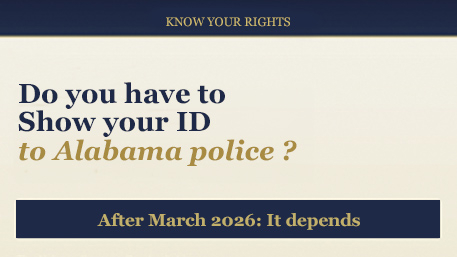
On March 13, 2026, the Alabama Supreme Court issued a 6-3 decision in Jennings v. Smith that significantly expanded what law enforcement can demand during an investigative stop in this state. The ruling has immediate, practical consequences for anyone who is stopped by police in Birmingham, and it is already being cited in pending criminal cases across Jefferson County. Every Alabama resident should understand what the ruling says, what it does not say, and how to handle a police encounter under the new rules.
The Background: How We Got Here
The case arose from a 2022 incident in Childersburg, Alabama. Michael Jennings, a Black pastor, was watering flowers at his neighbor's house while the neighbor was on vacation. Another neighbor who did not recognize him called the police. When officers arrived, Jennings explained that he was there with permission, but when they asked for his identification he became agitated and refused to produce any ID. He was arrested and charged with obstructing governmental operations under Alabama Code Section 13A-10-2. The obstruction charge was ultimately dismissed.
Jennings then sued the officers and the City of Childersburg for violating his constitutional rights. The case traveled through the federal courts, and the Eleventh Circuit Court of Appeals eventually certified a question of state law to the Alabama Supreme Court: does Alabama's stop-and-identify statute, Alabama Code Section 15-5-30, allow officers to demand physical identification when a person gives an incomplete or unsatisfactory oral response?
What the Court Actually Held
Writing for the majority, Justice William Sellers held that when a person stopped during a lawful Terry stop provides an incomplete or unsatisfactory oral response, officers may demand physical identification to verify the information they are legally entitled to obtain. The court relied heavily on the United States Supreme Court's 2004 decision in Hiibel v. Sixth Judicial District Court of Nevada, which upheld state stop-and-identify statutes under the Fourth Amendment.
The critical language in the opinion is this: if a person provides only a partial or vague name, such as "Pastor Jennings" without a full legal surname, or gives an imprecise address, the officer may demand physical identification to confirm the information. If the person refuses, the officer has two options: arrest the person for obstructing a governmental function under Section 13A-10-2, or continue the detention to seek additional identifying information.
The dissent, authored by Associate Justice Brady Mendheim Jr. and joined by Chief Justice Sarah Stewart and Associate Justice Chris McCool, agreed with the majority on the merits of the constitutional question but argued that the court should not have reached the issue in this procedural posture.
What This Changes for Birmingham Residents in Practice
Before Jennings, there was real uncertainty in Alabama about whether an officer could arrest you for declining to produce a physical ID after you had already stated your name and address verbally. The Eleventh Circuit's 2024 ruling in the Jennings case had strongly suggested that arrest in that circumstance lacked probable cause. The Alabama Supreme Court has now reversed that understanding as a matter of state law.
Under current Alabama law, if an officer has reasonable, articulable suspicion that you are involved in criminal activity, you can be lawfully detained in a Terry stop. During that stop, the officer can require you to provide your name, your address, and an explanation of your actions. If your oral response is complete and the officer can verify your identity, that is the end of the inquiry. If your oral response is incomplete, vague, or inconsistent with what the officer can confirm independently, the officer can now demand physical identification. Refusing to produce it exposes you to arrest for obstructing governmental operations, a Class A misdemeanor carrying up to one year in jail and a $6,000 fine.
What Has Not Changed
The ruling does not give officers unlimited authority to demand ID from anyone they encounter. Several constitutional limits remain firmly in place. An officer must still have reasonable suspicion of criminal activity before a lawful Terry stop can occur in the first place. If the stop itself is unlawful, any arrest that follows a refusal to produce ID is also unlawful. The officer cannot demand ID from a passenger in a vehicle unless the officer has independent reasonable suspicion that the passenger personally is involved in criminal activity. A consensual encounter, where the officer approaches without reasonable suspicion, does not trigger any obligation to identify yourself at all, and you remain free to decline to answer and walk away.
You also retain your Fifth Amendment right against self-incrimination beyond the identification itself. The officer can require your name and address. The officer cannot require you to answer questions about where you have been, what you have in your pockets, or whether you have been drinking.
The Practical Rule for Every Alabama Encounter
If you are stopped by police in Alabama after March 2026, here is how to handle the interaction. First, ask calmly and clearly whether you are being detained or are free to leave. If the officer says you are free to leave, leave. Second, if you are being detained, provide your full legal name, your current address, and a brief, truthful explanation of what you are doing. Third, if the officer asks for physical ID and you have it on you, produce it. Fourth, decline politely but firmly to answer any further questions without an attorney, and decline consent to any search of your person, vehicle, or belongings. Fifth, remember the oldest rule in criminal defense: comply on the scene and challenge the legality later. The side of the road is not the place to argue the Fourth Amendment.
If You Were Arrested for Obstruction or Failure to Identify, Your Case May Still Have Defenses
The Jennings ruling is new, and every case still turns on whether the underlying stop was supported by reasonable suspicion and whether the officer's demand for ID was reasonably related to the investigation. Racial profiling, pretextual stops, and retaliatory arrests for protected speech remain constitutionally impermissible regardless of what state law allows. If you have been charged with obstructing governmental operations, resisting arrest, or any related offense after a stop-and-identify encounter, do not plead guilty without a careful review of the facts.
Elizabeth Hunter & Associates represents clients across the Birmingham metro in obstruction, resisting arrest, and civil rights cases stemming from police encounters. Call (205) 203-9439 to discuss your case in confidence.